Emergency Plumber Work at a Principal Residence in Hawaii
@elliottytgn988
September 24, 2026 · 18 min read
A plumbing emergency has a way of collapsing time. A leak under pressure can turn a quiet afternoon into a race for towels, shutoff valves, and phone calls. In Hawaii, that stress is compounded by a legal reality that many homeowners do not fully understand until something goes wrong: plumbing is a licensed trade, and the state draws a clear line around who may perform plumbing work.
That matters even more when the emergency happens at a principal residence. People often assume that urgency changes the rules. In a narrow sense, Hawaii does allow a limited exception for emergency plumbing repair work in a person’s principal residence. But that exception is exactly that, limited. It does not open the door to all emergency plumbing work, and it does not cover several of the jobs that commonly prompt calls to an emergency plumber in the first place.
If you own or occupy a home on the Big Island, especially in West Hawaii, understanding that distinction can save you from making a rushed decision that creates a second problem after the first one. It can also help you ask better questions when you contact a plumber Kona homeowners trust for urgent service.
The legal starting point in Hawaii
In Hawaii, a person may not act or hold themselves out as a plumber without a license. Plumbing work must generally be performed by a licensed journey worker plumber or master plumber. Apprentices and helpers may work only under supervision.
That is not a technicality. It is the framework the state uses to protect health, safety, and property. Plumbing systems carry potable water, remove wastewater, and, depending on the installation, connect with fuel-burning equipment, pressure vessels, and building infrastructure. A poor repair can cause hidden water damage, contamination concerns, or expensive downstream failure.
The state also ties contractor oversight to licensing requirements. Hawaii’s regulatory guidance makes clear that plumbing contractors must employ licensed plumbers to perform the actual work. In practical terms, that means the company name on the truck is only part of the picture. The people doing the work also matter.
For homeowners, this is where panic can lead to bad judgment. A late-night online search for a “plumber near me” often pulls up a mix of contractors, handymen, referral services, and marketing pages. During an emergency, the temptation is to focus only on speed. Speed matters, but in Hawaii, licensing matters too.
The narrow emergency exception for a principal residence
Hawaii law does recognize that emergencies happen at home. There is a limited exception for emergency plumbing repair work in a person’s principal residence. That language is important.
First, it is tied to a principal residence. Second, it is limited. Third, and most important for real-world decision-making, the exception does not apply to some of the most serious categories of plumbing work.
The exception does not apply to sewer lines, drains, gas lines, or certain fixtures such as heaters and water closets.
That single sentence carries a lot of weight. Many homeowners hear “emergency plumbing” and think of a backed-up line, a failing water heater, or a toilet issue. Under Hawaii’s rules, those are exactly the kinds of situations where the principal-residence emergency exception may not help you. If the problem involves sewer line repair, drain cleaning, gas-related plumbing, a heater, or a water closet, the safer and legally appropriate course is to bring in properly licensed professionals.
This is where experience matters. In the field, plumbing problems rarely arrive with a neat label attached. Water on the floor could be a supply leak, a drain failure, a fixture problem, or a hidden issue tied to a larger system. Homeowners often describe symptoms, not causes. A puddle near a bathroom wall might sound minor over the phone, then turn out to involve a toilet connection, a drain stack, or something else outside the narrow space of a do-it-yourself emergency exception.
That uncertainty is one reason rushed self-diagnosis is risky.
Why the exception is narrower than people expect
The state’s carve-out for limited emergency repair at a principal residence makes sense only when you see it against the purpose of plumbing regulation. Hawaii is not merely trying to control paperwork. It is trying to ensure that actual plumbing work is done by people trained and authorized to do it.
That explains why certain systems are excluded. Sewer lines and drains affect sanitation and wastewater handling. Gas lines carry obvious safety implications. Heaters and water closets are fixtures where installation and repair errors can have immediate consequences and larger code implications.
Even where a homeowner believes the issue is simple, the actual scope can expand quickly. A call that begins as “my hot water is out” may involve a system where water heater repair is not the only question. On the Big Island, some properties also rely on solar water heating systems, and solar water heater repair can involve components and connections that deserve qualified attention. Likewise, what starts as “the sink won’t drain” can lead to a more serious blockage or a line issue better understood as sewer line repair rather than routine drain cleaning.
A professional plumber does not just replace a part. A good one identifies what category of problem is actually present, and whether that category triggers licensing and code concerns beyond the immediate symptom.
The reality of emergency calls in West Hawaii
In Kailua-Kona and the broader West Hawaii market, plumbing companies commonly advertise a wide range of services. Residential work is a given, but local providers also promote drain cleaning, sewer line repair, water heater repair and installation, leak detection, solar water heating, and commercial plumbing installation. Many also serve commercial accounts, and a commercial plumber may be equipped for larger and more complex systems than a strictly residential operator.
That broad service mix is useful for homeowners because plumbing failures do not always stay neatly inside one box. A property can have a residential emergency that overlaps with wastewater infrastructure, heating equipment, or system-wide troubleshooting. If you are searching for a plumber Kona residents regularly call, it helps to know whether the company’s expertise matches the nature of the problem, not just whether someone can arrive quickly.
This is especially true when the emergency exception does not apply. If the issue involves drains, sewer lines, gas lines, heaters, or water closets, you want licensed personnel from the outset. The cost of one wrong assumption can be significant. Water keeps moving while people debate scope. Damage spreads behind walls and beneath flooring long before it becomes visible at the surface.
What homeowners should do first when water is where it should not be
The first response in a plumbing emergency is not a repair. It is control.
If you can safely shut off the water affecting the problem area, do that. If the source is not obvious, the home’s main water shutoff may be the fastest way to limit damage. After that, the next smart move is documentation and triage. Photos, a brief record of what happened, and a clear description of symptoms help the plumber understand urgency and probable scope before arrival.
Then comes the crucial judgment call: is this the kind of issue that falls within Hawaii’s narrow principal-residence emergency exception, or does it involve one of the excluded categories?
For many households, that question alone is enough to justify calling a licensed emergency plumber rather than trying to parse the legal edge cases under stress. A leak may look small but still involve a heater connection. A “clog” may actually be a drain or sewer matter. A bathroom issue may involve a water closet even if the exact failure point is not obvious.
The safest habit is to treat uncertainty as a reason to escalate, not a reason to experiment.
A practical way to think through the next call
When homeowners are under pressure, they tend to ask only one question: “How soon can you get here?” A better approach is to ask a few direct questions that clarify whether the company is set up to handle the work properly.
- Are the actual plumbing repairs performed by licensed plumbers?
- Does your team handle emergency plumber calls involving residential systems in Hawaii?
- If the issue involves water heater repair, drain cleaning, sewer line repair, or solar water heater repair, do you have the right licensed personnel for that scope?
- If the problem turns out to be broader than a minor repair, can you manage the next step without handing it off?
- Do you also handle related work on larger properties or commercial plumbing installation if the system is part of a mixed-use site?
Those questions are not about playing inspector. They are about confirming that the person showing up can lawfully and competently do the work. In Hawaii, that is not an abstract concern.
Why continuing competency matters more than most people realize
Licensing is not static. Hawaii requires plumber license renewals to include continuing competency in the 2021 Uniform Plumbing Code for the current renewal cycle ending June 30, 2027.

For homeowners, this may sound bureaucratic, but it speaks to something practical. Plumbing standards evolve. Installations, materials, code interpretations, and best practices do not stand still. An emergency repair is often made under pressure, in awkward access conditions, and with limited time for deliberation. That is exactly when current code knowledge matters most.
A well-trained plumber is not simply someone who has “seen it all.” Experience is essential, but so is staying current. The combination matters. In real jobs, experienced judgment answers questions that manuals do not. Current competency answers questions that old habits can get wrong.
That is one reason the cheapest available option is not always the least expensive outcome. A repair that stops the leak but creates a code or system problem is not a bargain.
The common misunderstandings around drains, toilets, and heaters
Among homeowners, three categories cause the most confusion during an emergency: drains, toilets, and water heaters.
Drains feel simple because everyone has dealt with a slow sink or tub at some point. But Hawaii’s principal-residence emergency exception does not apply to drains. That alone should make people careful. A blocked line can involve more than inconvenience. It can indicate a larger system obstruction, wastewater backup, or a problem that belongs in the sewer line repair category.
Toilets create similar confusion because many people assume a basic fix is always fair game. Yet the exception does not apply to water closets. The legal wording matters less to a homeowner than the practical takeaway: once the issue reaches that fixture category, licensed plumbing work is the safer path.
Water heaters are another frequent trouble spot. Homeowners often focus on lost hot water, but the repair can involve connections, valves, pressure, and related system concerns. Since the exception does not apply to heaters, water heater repair belongs on the licensed side of the line. The same caution should extend to solar water heater repair, especially in a market where solar hot water systems are part of the service offerings advertised by local plumbing providers.
A homeowner in a rush may see each of these as a contained inconvenience. A licensed plumber sees them as systems with health, safety, and code implications.
When residential and commercial experience overlap
It may seem odd to mention a commercial plumber in an article about a principal residence, but in places like Kona and across West Hawaii, service capabilities often overlap. Companies that handle residential emergencies may also perform commercial plumbing installation and larger system work.
That crossover can be useful. A contractor with both residential and commercial experience may be better equipped for properties with more complex plumbing layouts, accessory structures, or mixed-use characteristics. It does not mean every home needs a commercial plumber. It means that depth of experience can matter when the emergency is not straightforward.
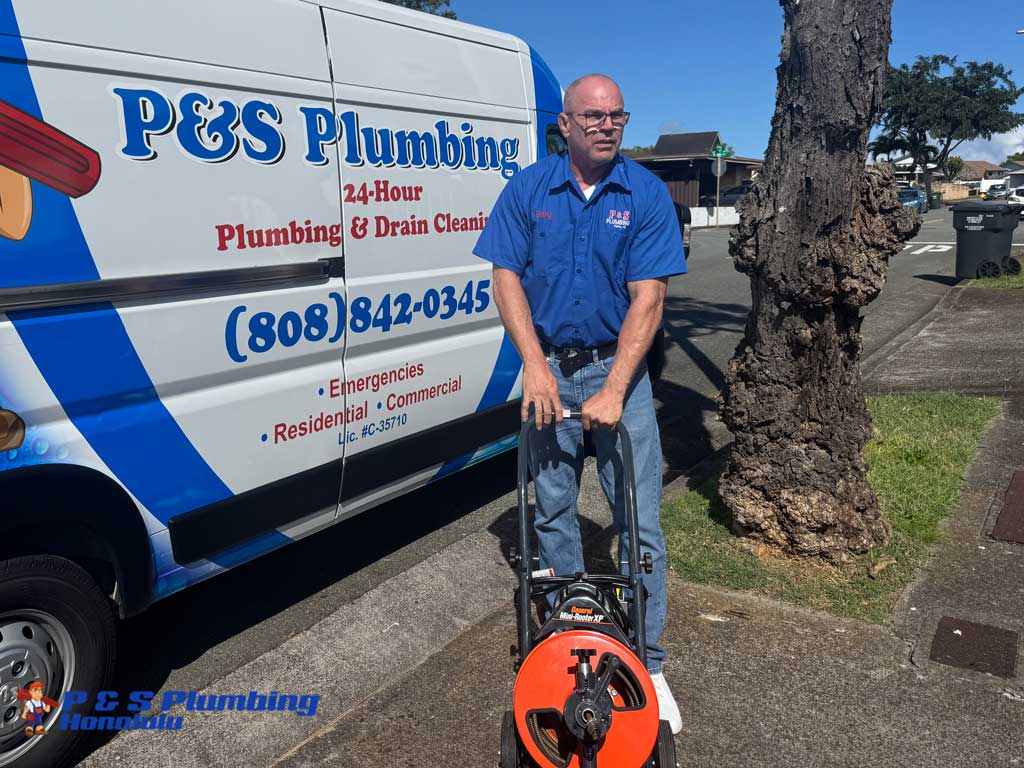
There is another angle too. Some wastewater-related property projects in Hawaii may require a licensed plumber and, depending on scope, possibly a licensed electrician as well. Homeowners do not need to become experts in regulatory categories, but they should understand that plumbing emergencies can intersect with broader project requirements. Once the problem moves beyond a simple visible leak, the right response often involves more than one trade and more than one permit or compliance question.
The judgment call that separates a quick fix from a costly mistake
The hardest part of any plumbing emergency is that the true problem is often hidden. Water travels. Waste lines fail out of sight. Symptoms lag behind causes. By the time a homeowner notices damage, the issue may already be wider than it appears.
Professionals learn to be skeptical of first impressions. A ceiling stain does not tell you where the leak started. A gurgling fixture does not tell you whether the issue is local or systemic. No hot water does not tell you whether you are looking at a service issue, equipment failure, or a problem outside the homeowner’s emergency exception.

That is why emergency response in Hawaii should start with a legal and practical assumption: if the work is clearly plumbing, licensed professionals are the default, and the principal-residence exception is narrow enough that it should be treated with caution, not confidence.
There is also a behavioral piece to this. People in distress tend to overestimate what they can safely handle and underestimate what is excluded. They want the problem over with. That is understandable. But urgency does not expand the law, and it does not make a drain, sewer, gas, heater, or water closet problem any less technical.
Choosing wisely when the search becomes urgent
Most emergency service searches begin the same way, with a phrase like “plumber near me” typed into a phone while water is still running or damage is still spreading. The search itself is easy. The selection is where mistakes happen.
A good emergency call is not just about who answers first. It is about who is actually equipped to perform the work under Hawaii’s rules. If you are in West Hawaii, looking for a plumber Kona homeowners can rely on, the key is to match urgency with legitimacy. Ask whether licensed plumbers perform the work. Be candid about symptoms. Mention if the issue may involve a heater, drain, sewer line, or toilet. Those details matter because they change both the repair path and the legal framework.
If the company also handles water heater repair, solar water heater repair, drain cleaning, sewer line repair, or commercial plumbing installation, that breadth can be useful. It suggests the call will https://keeganuznn303.terracolumn.com/posts/plumber-kona-services-often-listed-by-local-providers not fall apart if the diagnosis changes once the plumber is on site. Emergencies often do.
A final practical perspective for Hawaii homeowners
The strongest protection a homeowner has during a plumbing emergency is not a wrench or a wet vacuum. It is clarity.
Clarity about what Hawaii law requires. Clarity about how narrow the principal-residence emergency exception really is. Clarity about the kinds of problems that are specifically outside that exception, including drains, sewer lines, gas lines, heaters, and water closets. And clarity about why licensed work is the rule rather than the inconvenience.
The immediate goal in any plumbing emergency is to stop damage and restore function. The longer-term goal is to avoid turning one urgent problem into a chain of preventable ones. On that point, the law and practical experience point in the same direction. When the scope is uncertain, when the issue touches an excluded category, or when the repair involves systems with safety and sanitation implications, call a licensed plumber.
That is not hesitation. It is good judgment. In Hawaii, especially at a principal residence where people may be tempted to stretch the emergency exception beyond what it actually allows, good judgment is often the difference between a controlled repair and a much more expensive lesson.
Name: P&S Plumbing Kona
Address: 73-5573 Kauhola St Bay #11, Kailua-Kona, HI 96740, United States
Phone: 808-325-3892
Website: https://www.psplumbinghawaii.com/
Email: [email protected]
Hours:
Sunday: Open 24 hours
Monday: Open 24 hours
Tuesday: Open 24 hours
Wednesday: Open 24 hours
Thursday: Open 24 hours
Friday: Open 24 hours
Saturday: Open 24 hours
Time zone: Hawaii-Aleutian Time
Open-location code / Plus code: MXQJ+P4 Kailua-Kona, Hawaii, USA
Map/listing URL: https://www.google.com/maps/search/?api=1&query=Google&query_place_id=ChIJwc_thcwNVHkRhwCIvILuP8w
Embed iframe:
Socials:
https://www.facebook.com/psplumbingkona/
https://x.com/PSPlumbingKona
https://soundcloud.com/p-s-plumbing-kona
https://www.youtube.com/@PSPlumbingKonaHawaii
P&S Plumbing Kona provides plumbing services from its Big Island headquarters on Kauhola Street in Kailua-Kona.
The official website lists Kona phone service at 808-325-3892 and also lists Hilo and Honolulu service contacts.
P&S Plumbing provides residential plumbing, commercial plumbing, drain and sewer service, water heater work, plumbing repairs, leak detection, fixture repair, kitchen plumbing, bathroom plumbing, and emergency plumbing support.
The official site lists the Big Island headquarters at 73-5573 Kauhola Street, Bay 11, Kailua Kona, HI 96740.
The company’s official site lists Hawaii State License Number CT-35710 and describes P&S Plumbing as licensed and insured.
Customers can contact P&S Plumbing Kona for drain cleaning, sewer-line concerns, water heater service, clogged toilets, fixture repairs, plumbing leak detection, pipe-lining needs, bathroom remodeling plumbing, kitchen plumbing, commercial plumbing, and urgent plumbing requests.
For plumbing service in Kailua-Kona and West Hawaii, call 808-325-3892 or visit https://www.psplumbinghawaii.com/
The public map listing uses plus code MXQJ+P4 Kailua-Kona, Hawaii, USA and can help customers find P&S Plumbing Kona near Kauhola Street.
Popular Questions About P&S Plumbing Kona
What does P&S Plumbing Kona provide?
P&S Plumbing Kona provides plumbing services for residential and commercial customers, including drain cleaning, sewer and drain service, water heater service, plumbing repairs, fixture repair and installation, leak detection, kitchen plumbing, bathroom plumbing, and 24-hour emergency plumbing.
Where is P&S Plumbing Kona located?
The official contact page lists the Kona location at 73-5573 Kauhola Street, Bay 11, Kailua Kona, HI 96740. The listing address is 73-5573 Kauhola St Bay #11, Kailua-Kona, HI 96740, United States.
What phone number should Kona customers call?
The official website lists Kona phone number 808-325-3892.
What is the email address for P&S Plumbing Kona?
The email address is [email protected].
What are P&S Plumbing Kona’s hours?
The listing hours show P&S Plumbing Kona as open 24 hours a day, seven days a week, Hawaii-Aleutian Time. The official website also references 24-hour emergency plumbing service.
Is P&S Plumbing licensed?
The official website lists Hawaii State License Number CT-35710. Customers can confirm license status directly with the relevant Hawaii licensing authority before hiring.
Does P&S Plumbing Kona offer emergency plumbing?
Yes. The official website references 24-hour emergency plumbing service and emergency services availability.
Does P&S Plumbing handle water heaters?
Yes. The official website lists water heater installation and repair, including tankless, solar, conventional water heaters, and boiler setup and repair.
What areas does P&S Plumbing serve from Kona?
The official service-area page lists Big Island / Kona communities including Kona, Holualoa, Kukio, Waikoloa Village, Kalaoa, Captain Cook, Kahaluu-Keauhou, Keauhou, Kainaliu, Waimea, Puako, and Kealakekua.
How do I contact P&S Plumbing Kona?
Call 808-325-3892 or visit https://www.psplumbinghawaii.com/. Social profiles: Facebook, X, SoundCloud, and YouTube.
Landmarks Near Kailua-Kona, HI
Kauhola Street: The street listed for P&S Plumbing Kona’s Big Island headquarters and a practical reference point for the Kailua-Kona location.
Queen Kaʻahumanu Highway: A major West Hawaii route connecting Kailua-Kona, Kona International Airport, Waikoloa, and nearby coastal communities.
Ellison Onizuka Kona International Airport: A major transportation landmark north of Kailua-Kona and near local service routes.
Kailua-Kona town: A central West Hawaii community served by local plumbing contractors.
Old Kona Airport State Recreation Area: A well-known Kailua-Kona landmark near residential and commercial areas.
Kailua Pier: A central waterfront landmark in Kailua-Kona and a common local reference point.
Aliʻi Drive: A major coastal route with homes, condos, restaurants, shops, and visitor properties.
Honokōhau Harbor: A marina and commercial harbor area near Kailua-Kona and local business routes.
Kaloko-Honokōhau National Historical Park: A major cultural and coastal landmark north of Kailua-Kona.
Keauhou: A South Kona community with homes, condos, resorts, and plumbing service needs.
Holualoa: An upland Kona community with residential properties and local businesses.
Waikoloa Village: A West Hawaii community listed on P&S Plumbing’s service-area page.
Waimea: A Big Island community listed on P&S Plumbing’s service-area page.
Kealakekua: A South Kona community listed on P&S Plumbing’s service-area page.
Captain Cook: A South Kona community listed within P&S Plumbing’s Big Island / Kona service-area references.
For residential plumbing, commercial plumbing, drain cleaning, sewer-line repair, water heater service, leak detection, fixture work, bathroom plumbing, kitchen plumbing, or 24-hour emergency plumbing near these Kailua-Kona and West Hawaii landmarks, contact P&S Plumbing Kona at 808-325-3892 or visit https://www.psplumbinghawaii.com/